Area Real Estate News & Market Trends

You’ll find our blog to be a wealth of information, covering everything from local market statistics and home values to community happenings. That’s because we care about the community and want to help you find your place in it. Please reach out if you have any questions at all. We’d love to talk with you!

Dec. 22, 2025

How To Stretch Your Options, Not Your Budget

our dream home may be closer than you think. See how rethinking your must-haves can unlock more affordable options in today’s market.

One of the biggest homebuying advantages you can give yourself today is surprisingly simple: a flexible wish list.

Think of it like this. Your wish list and your budget are the guardrails of your search. And when your budget needs to hold firm, there’s another lever you can pull. That’s seeing if you truly need all of your desired features. Because the truth is, a small compromise could be the difference between feeling stuck and getting the keys to your next home.

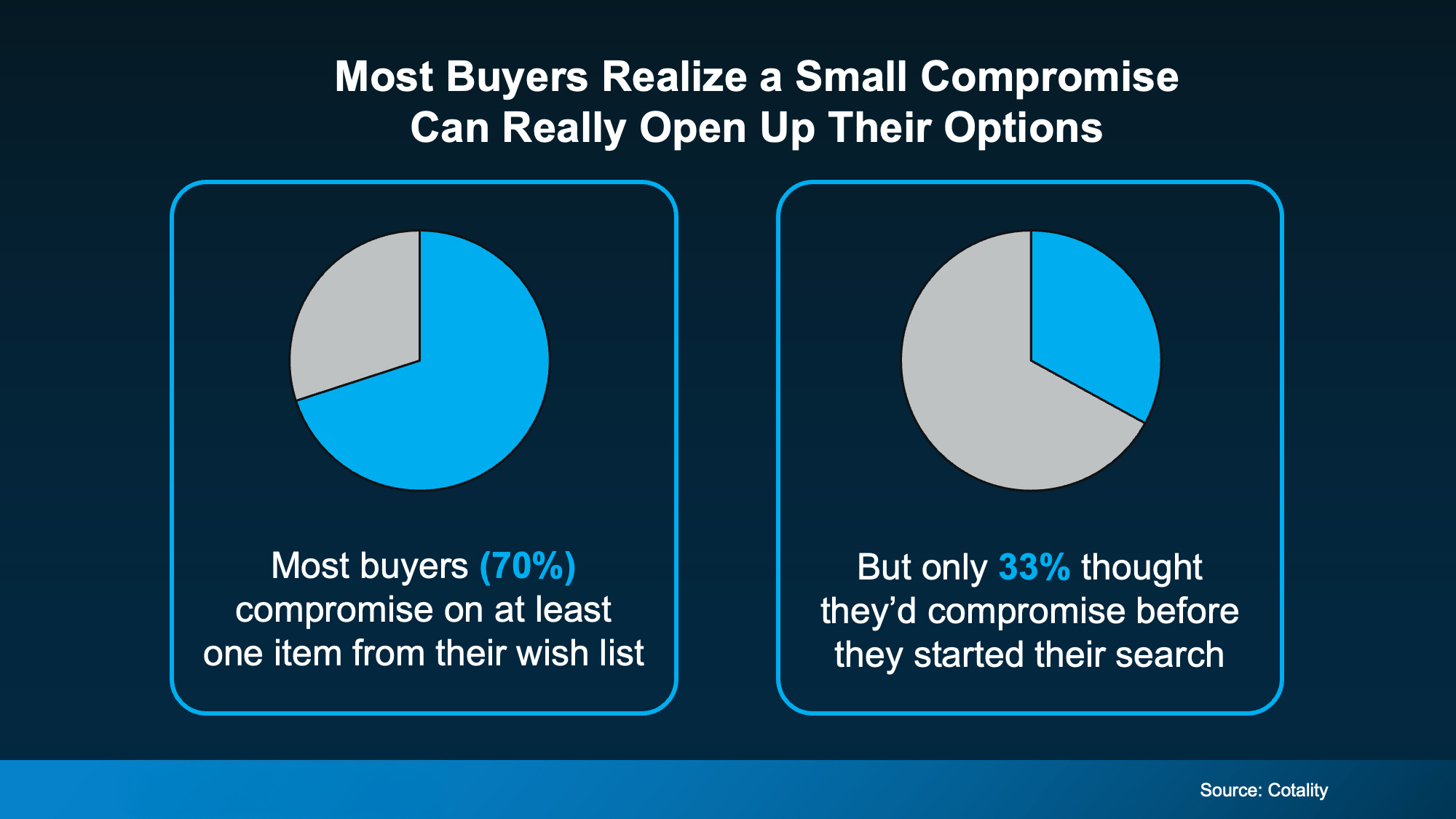
The data shows more buyers are using that strategy to offset affordability hurdles in today’s market. A recent study from Cotality found most buyers (70%) ended up compromising on one or more items from their original wish list. But before they started searching, only 33% expected to compromise at all:

Homebuyers small compromises

What changed? They realized something during the search. The things you can’t change matter far more than the things you can update later.

You can:

  • Install hardwood floors
  • Put in those marble countertops
  • Upgrade the bathrooms down the line.

You can’t as easily:

  • Add land
  • Tack on more bedrooms or bathrooms
  • Move the house closer to people you care about

In the end, things like the location, layout, and overall bones matter far more than the cosmetic features you can change later. And that realization is power.

A Simple Step That’ll Open More Doors

So, if you’re hitting a wall in your search or you’re browsing online and just not seeing “it,” here’s an easy exercise that can reset the whole experience. Write down everything you want in a home, then sort it into three buckets:

  • Must-Haves: Your non-negotiables. The things that make daily life workable: the number of bedrooms, the length of your commute, accessibility, safety, or being close to your family or support system.
  • Nice-to-Haves: Features you’d absolutely enjoy but aren’t truly essential. Some examples: a fenced-in backyard, dual closets in the owner’s suite, or a stamped patio.
  • Dream Features: The extras that would truly be over the top. They’re the things you think about when you say “one day, I want to have…” It’s great if you get them, but totally fine if you don’t (for now).

Once you divide your list, you’ll notice something. Your wish list can either limit your options or open them up.

Sometimes you’re treating “nice-to-haves” like “must-haves.” Loosen that up even a little, and suddenly more homes come into range – including homes you may have scrolled past that could actually work for your lifestyle.

Small Flexibility, Big Payoff

Your next home doesn’t need to check every box. It just needs to check the right ones.

Maybe that means considering a house that needs light cosmetic updates. Maybe it means choosing a slightly smaller yard for a better location.

These aren’t sacrifices. They’re worthwhile trade-offs that get you into a home. Just remember, anything cosmetic can be upgraded over time. But getting the right bones, the right layout, the right location? That’s what sets you up for the long run.

An Agent Helps You See the Possibilities

If you’re not sure what to hold firm on and where you can flex, that’s where a The DHC Group can be a game changer. They’ll help you spot the opportunities, walk you through what features you truly shouldn’t budge on, and determine which ones you can add later – when the time is right.

Bottom Line

If you’re ready to find a home that fits both your budget and your life, talk to Hennin and The DHC Group and look at your wish list together. With a local expert on your side, it’s easier to see where a little flexibility can open up a lot more opportunity.

Posted in Market News
Dec. 8, 2025

Is The American Dream Now Defined As “Month to Month”?

San Diego blog that illustrates the city’s worsening affordability crisis and the growing difficulty residents face in securing stable housing or buying a home

Only a small fraction of San Diego residents — about 15% — can afford to buy a typical home today. That reality is reshaping daily life and putting real strain on the community.

I’m 43, have spent 16 years in my career, and hold a master’s degree in journalism. I also earn more than the median income for San Diegans over 25, which is around $57,000. By most measures, I’m doing better than average. Yet owning a home in this city is completely out of reach for me, just as it is for most people. Not long ago, even San Diego’s mayor was renting.

Being single isn’t the reason, either. If I lived with a partner who made the same income as I do, we still wouldn’t qualify for a median-priced home. Only a small slice of families can. Slightly cheaper options exist, like studios or one-bedroom condos, but even those aren’t widely affordable.

People already know this, but the emotional and social effects are huge. For decades, homeownership has been a core part of the “American Dream.” The growing gap between that expectation and the current housing market is shaking long-held beliefs about stability and success.

Some might argue that the solution is simple: move somewhere cheaper. But this overlooks the fact that housing affordability has collapsed across the entire country. According to the National Association of Realtors, 2023 marked the lowest level of affordability since they began keeping track in 1989. This isn’t happening because people lack work ethic. Prices have risen far faster than wages, leaving Americans with fewer and fewer options.

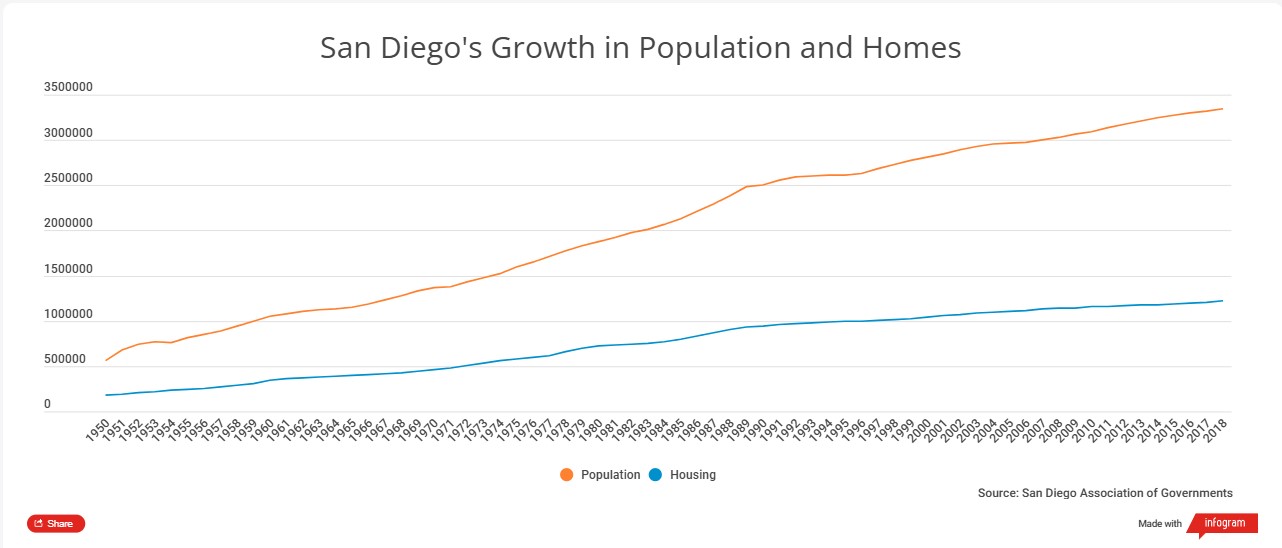
Local leaders often say the key is to build more homes. San Diego has increased home-building permits dramatically in 2023 and 2024 — nearly doubling previous levels. But even with that progress, the city remains far below what it needs to match the growing demand. For decades, the population grew much faster than the housing supply, and two strong years can’t undo that long-term imbalance.

San Diego Growth in Population and Homes


Some critics now claim supply isn’t the problem. Encinitas Mayor Bruce Ehlers, for example, points to recent population dips in the state and county and argues that if fewer people live here, a shortage doesn’t exist. But population stagnation often reflects the housing crisis itself. When homes become too expensive, people leave or avoid starting families. A slight population decline doesn’t prove there’s enough housing — it’s a warning sign that people feel pushed out.

Despite slow progress, adding homes does work. Research from the Pew Charitable Trusts shows that when new housing is built, rent increases slow down — especially for older, more affordable units. Reporting in San Diego has found that neighborhoods permitting the most new housing saw smaller rent jumps than those that built little.

There’s also irony in the fact that Ehlers’ own daughter was able to buy a condo in a new development in Encinitas — the type of project local leaders long resisted. Those homes are still expensive, but they’re far cheaper than the area’s median price. Even so, Ehlers rejects the idea that new housing is helping younger generations gain a foothold.

Many people share that skepticism because the progress feels too slow. If expanding supply is the only strategy elected leaders can offer, public support may fade.

Some officials, like San Diego City Councilmember Sean Elo-Rivera, argue that government needs to step back into housing production more directly — something it did decades ago. He believes large-scale public investment and ownership may be necessary to keep housing from being driven entirely by profit.

Housing is tied to a wider affordability challenge. Wages aren’t keeping up with rising costs in health care, education, utilities, insurance, and daily essentials. Meanwhile, corporate profits continue to climb.

Housing sits at the center of these problems. It shapes financial security, opportunity, and mental well-being. Without a long-term plan to address the housing shortage, elected leaders won’t just be failing the public — they may soon find themselves being the ones asked to “move.”

While homeownership in San Diego still difficult, making the right decision about buying or selling can feel like a real challenge. Whether you're buying a home, downsizing or upsizing your current home, investing or cashing out all together...if you’re open to having the right agent team put in the work for you, we can get it done.

The DHC Group can help you explore what’s possible and present pain free options that might work for you.

Posted in Market Updates
Dec. 1, 2025

The Top 2 Things Homeowners Need To Know Before Selling

Learn the top pricing and timing strategies homeowners must know to sell faster and maximize results in today’s real estate market.

Here’s something you should know before you sell your house. The homeowners who win in today’s market aren’t the ones waiting it out or stepping back. They’re the ones who adapt from the start.

A number of homeowners this year didn’t get the outcome they wanted. But it’s not because something’s wrong with the market. It’s because something wasn’t right with their expectations.

Realtor.com reports 57% more homes have been taken off the market compared to last year. That means they listed… but didn’t sell. But here’s the honest truth. It was mostly because of two things: price and timing.

And if the seller had come in with the right mindset on each, their sale would’ve gone differently. Here are the top 2 things you can learn from those other sellers.

1. Price It Right from Day 1

Let’s start with the most common sticking point: the asking price. Today, 8 in 10 sellers expect to get their asking price or more. But that confidence doesn’t always line up with reality.

According to SDAR, only 1 in 4 (25.3%) sellers are actually getting more than their list price.

And here’s where the mismatch is coming from.

A few years ago, you could set any price and buyers would come running, no matter what the price tag said. Odds are, you’d still sell for over asking. But things are different now.

Buyers have more options than they’ve had in years, so they can afford to be more selective. If your price feels even a little high to them, it’ll get overlooked in a heartbeat.

And for the homeowners who had that happen, some end up pulling their listings instead of making a simple adjustment that could have changed everything. Which is a shame, honestly. Because a small price tweak is usually all it takes to bring buyers in and get the deal done.

According to HousingWire, the average price cut right now is just 4%.

Think about that. Other sellers are listing too high and giving up rather than dropping their price 4%. If they’d just started 4% lower, they may have already sold. So, before you list, talk to your agent about what’s working nearby. They’ll help you find the sweet spot that’s competitive, realistic, and still protecting your bottom line.

And here’s the kicker. If you’ve been in your home for a while, your equity gives you room to set your list price more competitively and still come out way ahead. Unfortunately, those other sellers didn’t seem to realize that.

2. Don’t Rush the Process

Another common misstep: expecting your house to sell in a weekend.

Many sellers right now remember when homes sold in as little as hours – and they expect that to happen today. But in most markets, that’s not the reality anymore.

It takes closer to 60 days to go from listed to sold, which is actually normal (see the gray in the graph below):

It just feels slower because they’re comparing it to the lightning-fast pace of 2020 and 2021.

Think of it like driving 65 mph on the highway, then exiting and going 25. It feels like you’re crawling, but it’s actually the right speed for where you are. That’s what other sellers can’t seem to get over. But you can get ahead of that, by knowing what to expect.

Today’s buyers are more intentional. They’re taking their time, weighing their options, and making thoughtful decisions, which is creating a much healthier housing market.

So, if you’re planning to sell, don’t expect it to happen instantly. And don’t assume your house won’t sell if it doesn’t go under contract in the first weekend.

It’s normal for these things to take time.

If you want to make sure your house sells as quickly as possible, talk to your agent about ways to stand out, whether that’s through staging, photography, or strategic pricing. With the right advice, the right price, and the right prep work, it can still sell quickly.

Bottom Line

If you’re thinking about selling, don’t let the market discourage you, let it guide you. The listings that didn’t sell this year weren’t doomed. They just started with the wrong strategy.

You can still win if you price right, are patient, and work with Hennin and The DHC Group, who knows how to position your home from the start.

Because in today’s market, success isn’t about waiting for conditions to change. It’s about getting your expectations right from day one.

While homeownership in San Diego still difficult, making the right decision about buying or selling can feel like a real challenge. Whether you're buying a home, downsizing or upsizing your current home, investing or cashing out all together...if you’re open to having the right agent team put in the work for you, we can get it done.

The DHC Group can help you explore what’s possible and present pain free options that might work for you.

Posted in Market News
Nov. 10, 2025

2026 Home Prices...What Will Happen? Here's what experts say buyers should know now.

San Diego Home Price Predictions for 2026 — What Experts Expect

Homebuyers finally got some good news late this year when mortgage rates dropped considerably following the Federal Reserve's back-to-back rate cuts in September and October. With the Fed easing its stance on rates, the average 30-year fixed mortgage rate fell into the low-6% range, a notable improvement from the 7%-plus rates homebuyers faced earlier this year.

These lower borrowing costs are helping to reignite interest in the housing market, but the big question now is what happens next. Will improved affordability bring more buyers into the market and push home values higher? Could rising inventory finally give buyers the upper hand? Or will economic uncertainty keep things flat?

As 2026 approaches, the direction of home prices is also up in the air, so we spoke with mortgage and real estate professionals to get their predictions about where home prices could head next year. Here's what they had to say.

What will happen to home prices in 2026? Here's what experts say buyers should know now

Steven Glick, director of mortgage sales at Ziffy, an all-in-one AI-powered real estate investment platform, expects flat to mildly positive home appreciation at somewhere between 0.5% and 2%. 

"That band reflects two things moving in opposite directions: Rates have eased enough to coax demand back, but affordability is still stretched and supply is slowly rebuilding," Glick says.

This outlook signals a return to normalcy after years of extremes. 

"We expect moderate price growth in 2026 — likely below 4% on average across the country.

Karen Mayfield, national head of originations at mortgage-as-a-benefit provider Multiply Mortgage, sees a similar pattern unfolding as lower rates bring buyers and sellers back into the market. However, Mayfield predicts pent-up demand will absorb new home supply.

What could happen in 2026 to cause home prices to rise?

Several conditions could push home prices higher in 2026, experts say. Here's what could cause home prices to rise next year:

  • Mortgage rates drift below 6% and stay there. "Each quarter-point matters for monthly payments and buyer qualifying power," says Glick. "With the Fed already easing and signaling more to come, a gentle slide in mortgage rates would firm demand."
  • The labor market holds steady. "If employment is stable, more people will come off the fence and buy," says Joe Chung, a realtor with Coldwell Banker. When demand improves, prices tend to climb.
  • Construction costs rise. "Tariff-driven cost increases will push new home prices higher, creating a floor for existing home values," Mayfield says.

What could happen in 2026 to cause home prices to fall?

On the flip side, experts say a few factors, including the following, could push home prices down next year: 

  • Mortgage rates climb back up. "An inflation surprise or wider risk premiums would lift the 10-year Treasury and, by extension, 30-year mortgages," Glick says. As affordability worsens, fewer buyers can qualify, weakening demand and putting downward pressure on prices.
  • Housing supply surges unexpectedly. According to Mayfield, a wave of baby boomers downsizing (meaning there are more home sellers) could flood the market with inventory faster than buyers can absorb it.
  • The economy weakens. Rising unemployment or a broader economic downturn would reduce buyer demand and purchasing power.

Chung cautions that the market remains fragile. 

"Small shifts tend to 'freak out' confidence, which can soften values nationally," Chung says.

What could happen in 2026 to cause home prices to stay the same?

The most probable path forward requires the following conditions to hold:

  • Mortgage rates and inventory move in tandem. Glick describes this as a "push-pull balance," where improved affordability adds demand while growing supply adds choice, netting to flat-ish national prices.
  • Economic conditions stay predictable. Mayfield emphasizes the importance of stability. "The key is absence of shocks — no rate spikes, no inventory floods and no major policy changes that dramatically alter buyer or seller behavior," Mayfield says.
  • Regional differences average out. Some Sun Belt and pandemic-boom metros continue digesting their 2021 to 2022 price surges. Meanwhile, supply-constrained Northeastern and Midwestern markets hold firm. "Nationally, that averages out near zero to low-single-digit gains," Glick says.

The bottom line

Experts largely expect home prices to stay stable with modest growth in 2026, but that doesn't mean you should wait to buy. Lock in of the home and payment work for you today.

Rates are already lower than they were earlier in 2025. There's no guarantee 2026 gives you meaningfully lower rates, even a small price rise or more bidding can offset a minor rate dip. NEw economic data or Fed policy changes can shift mortgage rates quickly and without notice.

So if the numbers work for you now, it may be wise to move forward. 

While homeownership in San Diego still difficult, making the right decision about buying or selling can feel like a real challenge. Whether you're buying a home, downsizing or upsizing your current home, investing or cashing out all together...if you’re open to having the right agent team put in the work for you, we can get it done.

The DHC Group can help you explore what’s possible and present pain free options that might work for you.

Posted in Market News
Nov. 4, 2025

How much does a $500,000 mortgage loan cost monthly after the Fed's rate cut?

See how the Fed’s October 2025 rate cut impacts $500,000 mortgage payments and refinance costs in San Diego.

Last week, the Federal Reserve delivered a quarter-point rate cut at the close of its October meeting, lowering the benchmark rate to a range of 3.75% to 4%, with the goal of helping to ease borrowing costs amid an elevated rate climate. That rate cut was the Fed's second consecutive cut of 2025 and followed a similar 25-basis point reduction in September. Despite the central bank's efforts to ease financial conditions, though, questions remain about what this second rate cut of 2025 means for everyday borrowers.

While the Fed doesn't set borrowing rates directly, its moves ripple through financial markets, and those effects are already showing. Home equity borrowing rates, for example, have fallen significantly in recent weeks. For those who want to enter the housing market, though, the Fed's impact on mortgage rates has been uneven. While mortgage rates have come down from their peaks earlier this year, the average 30-year fixed mortgage rate currently sits at 6.17%, a far cry from the sub-3% rates that were commonplace in 2021. 

For buyers weighing whether to jump into the market, understanding the real cost of borrowing in this environment is critical. So, how much would the monthly payments on a $500,000 mortgage loan be if calculated at today's average rates? Below, we'll crunch the payment costs.

For those opting for the traditional 30-year fixed mortgage loan at today's average rate of 6.17%, the monthly principal and interest payment comes to $3,052.62. That's before factoring in property taxes, homeowners' insurance or potential HOA fees — expenses that can easily add hundreds more to the monthly housing bill.

If you're willing to commit to a shorter timeline, a 15-year mortgage loan at today's average rate of 5.41% would bring the monthly payment to $4,061.58. The higher payment reflects the compressed repayment schedule, but it comes with a significant upside: You'll pay dramatically less interest over the life of the loan and build equity much faster.

Now let's compare that to what you would have paid at the start of the year for a $500,000, 30-year mortgage loan when the average rate sat at 7.04%. At that point in mid-January, the monthly payment on the same $500,000 loan would have been about $3,339.96. That means you could save about $290 per month at today's average rates, or rake in more than $3,400 per year in savings.

And now let's consider where rates stood just a year ago. In October 2024, the average 30-year rate hovered around 6.70%, which would have meant a monthly payment of roughly $3,226.39 on the same $500,000 loan. That means today's rate represents a savings of about $170 per month, or about $2,040 annually. 

How much would it cost to refinance a $500,000 mortgage at today's rates?

Homeowners with existing mortgages have their own calculations to make. If you locked in a rate above 7% in the past year or two, refinancing at today's rates could generate substantial savings, though you'll need to weigh those savings against closing costs. Here's what refinancing a $500,000 mortgage would look like at current average rates:

  • 15-year refinance at 5.82%: Your monthly principal and interest payment would be $4,170.82 on a 15-year mortgage refinance at today's rates. This aggressive payoff schedule means higher monthly payments, but you'll eliminate your mortgage debt in half the time and save a fortune in interest over the loan's life. This option makes the most sense for homeowners who can comfortably afford the larger payment and want to build equity quickly.
  • 30-year refinance at 6.49%: The monthly payment on a 30-year mortgage refinance at today's rates would be $3,157.06. This keeps your payment lower and more manageable while still offering savings compared to rates that were common earlier this year. It's a solid middle-ground option for those who want to reduce their monthly obligations without committing to the steeper payments of a 15-year loan.

The bottom line

The Fed's October rate cut has nudged mortgage and refinance rates down slightly, offering a modest but welcome reprieve for borrowers. Still, if you're considering buying or refinancing, it's important to shop around with multiple lenders and compare offers. Even a quarter-point difference in rate can translate to hundreds of dollars in annual savings, so be sure to do your homework and find the best (and most affordable) option for your needs.

While homeownership in San Diego still difficult, making the right decision about buying or selling can feel like a real challenge. Whether you're buying a home, downsizing or upsizing your current home, investing or cashing out all together...if you’re open to having the right agent team put in the work for you, we can get it done.

The DHC Group can help you explore what’s possible and present pain free options that might work for you.


Posted in Market News
Oct. 28, 2025

Will mortgage interest rates drop after this week's Fed meeting?

A blue percent sign next to a small house

AI-generated content may be incorrect.

All eyes will turn toward the Federal Reserve this week as the central bank holds its penultimate meeting of 2025 to determine monetary policy and the future of interest rates.

The bank issued a rate cut in its last meeting in September, its first of the year. That followed a pause for most of 2025 after the central bank cut rates three times in the final months of 2024. As of Monday morning, there was around a 97% chance the Fed would cut rates again in this week's meeting, according to the CME Group's FedWatch tool. While the expectation is that the federal funds rate will be reduced by 25 basis points, any relief here will help borrowers, even indirectly.

And that's especially true for homebuyers, some of whom have been contending with the highest mortgage rates on record in decades over the past few years. And while the Fed doesn't directly dictate what rates lenders offer borrowers, it does go a long way toward impacting them. But will mortgage interest rates actually drop after this week's Fed meeting? Or should borrowers expect them to hold steady a bit longer? Those are the questions we'll examine below.

Will mortgage interest rates drop after this week's Fed meeting?

The answer to this simple question is a bit more nuanced than it may seem on paper, and the timing may not align neatly enough to occur at the conclusion of the meeting on October 29. All one has to do is look at recent mortgage interest rate history to see that mortgage rates drop around the time of a Fed rate cut, but not always right after, and not necessarily by the same amount the Fed reduced rates by.

For example, mortgage interest rates fell to a two-year low in September 2024, a few hours before the Fed actually issued a larger-than-anticipated 50 basis point reduction at the time. And that same dynamic played out almost exactly one year later. When the central bank cut rates by 25 basis points last month, mortgage interest rates had already declined that morning to their lowest level in three years.

So, yes, mortgage interest rates could drop in connection with this week's Fed meeting, but that could occur preemptively, before the cut is issued. That's largely because lenders don't need the Fed to formally act to get ahead of that decision by reducing their offers. Many have already "priced in" this reduction, and that's why some borrowers may not see much of a material difference between the rates they see listed on online marketplaces today … and what they see on those same websites in the days following a cut. 

Keep an eye out, then, for timely (and fleeting) opportunities to lock in a low mortgage interest rate this week. And remember that after the two aforementioned rate drops, there were increases in the rate climate both times. So, if you find a low, affordable rate available this week, even if not quite as ideal as you'd have hoped for, consider locking it in anyway. You never know when these opportunities will present themselves again, and you can always refinance if and when they do.

What's been happening with mortgage interest rates lately?

Overall, rates have been on a slow but noticeable decline for all of 2025. Mortgage rates were averaging just 6.13% in mid-September alongside the Fed's rate-cutting action at the time. They then rose later in the month as data items that would normally influence the rate trajectory were either delayed or paused amid the ongoing government shutdown. But in recent weeks, the average rate on a 30-year mortgage term has again declined. That was 6.34% on October 2, 6.30% on October 9, 6.27% on October 16 and 6.19% on October 23, according to FreddieMac. 

So rates here are heading in the right, downward direction for borrowers. And they could fall again, not only this week but in the final weeks of the year, too, as projections surrounding another Fed rate cut when the bank meets for the last time in 2025 in December are also elevated.

The bottom line

Mortgage interest rates can potentially drop after this week's Fed meeting, or they could fall right before it, depending on the lender in question and their response to Fed rate activity. Some other lenders, however, may have already taken the step to adjust their offers to reflect a rate cut this week. Be ready to shop around for lenders and rates, however, as offers could be significantly different from lender to lender. And be prepared to lock in a below-average rate if found. As recent history illustrates, these opportunities may not last for very long.

While homeownership in San Diego still difficult, making the right decision about buying or selling can feel like a real challenge. Whether you're buying a home, downsizing or upsizing your current home, investing or cashing out all together...if you’re open to having the right agent team put in the work for you, we can get it done.

The DHC Group can help you explore what’s possible and present pain free options that might work for you.

Posted in Market News
Oct. 13, 2025

California Ends ‘Home Equity Theft’ by Closing the Last Loophole in Property Tax Foreclosures

Learn how California’s AB 418 law closes the loophole in property tax foreclosures, ensuring homeowners keep their home equity after government seizures.

In 2023, the Supreme Court issued a landmark ruling that reaffirmed a basic constitutional principle: When the government seizes property, it cannot keep more than what it is owed.

And yet, until this month, it was still happening to California homeowners who fell behind on their property taxes.

When a homeowner becomes delinquent on their property taxes, local governments place a lien on the property for the amount owed. Before the Supreme Court’s 2023 Tyler v. Hennepin County ruling, that power often went much further. Some governments seized tax-delinquent properties, sold them at auction, and kept all the proceeds—even after the tax debt was paid.

That meant a homeowner who owed only a few thousand dollars in back taxes could lose a property worth hundreds of thousands and receive nothing in return.

After the 2023 ruling, though, most states passed reforms that ensured homeowners received any excess proceeds. But in California, a loophole in the state’s tax code allowed counties to bypass public auctions and instead transfer tax-delinquent properties directly to other government agencies or nonprofit organizations.

While the policy may have been intended to serve the public good, it had devastating consequences. Without an auction, no sale took place and no proceeds were generated, depriving homeowners of all their remaining equity.

California’s fix: What AB 418 does

Earlier this month, Gov. Gavin Newsom signed Assembly Bill 418 into law, closing what the Pacific Legal Foundation called “the last major loophole” in the Golden State’s property tax foreclosure system. 

The new law bans local governments from keeping or transferring homes without providing compensation to the former owner, and ensures that any foreclosure generates a sale, and any surplus funds from a sale are returned to the homeowner.

While Newsom didn’t issue a public signing statement, property rights advocates hailed the reform as a historic victory. 

“For too long, California allowed local governments to strip homeowners of their life savings,” said Jim Manley, state policy director at the Pacific Legal Foundation. “With the signing of AB 418, that injustice ends.”

As many as 3.3% of California mortgage holders were delinquent on their property taxes in 2024, according to a recent Cotality report. That may sound like a small share, but in a state with nearly 40 million residents and a 55% homeownership rate, it represents hundreds of thousands of homeowners at risk of falling into tax foreclosure.

The reform caps off a decade-long campaign by PLF to end home equity theft nationwide. For California homeowners, it’s long-overdue protection from the government collecting more than what it’s owed. And for the remaining states practicing shadow equity theft, it’s a promising example of how to right these wrongs.

This is a "victory not just for California property owners, but for property rights everywhere,” Manley added. “With the signing of AB 418, that injustice ends.”

What it means for homeowners

For California homeowners, AB 418 doesn’t erase the risk of losing property over unpaid taxes—but it ensures they won’t lose everything. Counties can still foreclose if taxes go unpaid, but properties can no longer be transferred without a sale, and any equity remaining after the debt is settled must be returned to the original owner.

For California homeowners, AB 418 restores a basic promise first laid out in the Constitution’s Takings Clause: The government can collect what it’s owed.

Or, in the words of Chief Justice John Roberts: “A taxpayer must render unto Caesar what is Caesar’s, but no more.”

While homeownership in San Diego still difficult, making the right decision about buying or selling can feel like a real challenge. Whether you're buying a home, downsizing or upsizing your current home, investing or cashing out all together...if you’re open to having the right agent team put in the work for you, we can get it done.

The DHC Group can help you explore what’s possible and present pain free options that might work for you.

Posted in Market News
Oct. 7, 2025

Should You Unplug Chargers When Not in Use?

Getty Images / Kevin Brine

Chargers are essential for everyday devices - but is it safe to leave them plugged in when not in use? Discover what an expert says about energy use and safety.

In the average household, a wide variety of wireless devices require chargers, including phones, tablets, laptops, headphones, keyboards, speakers, and other electronic devices. Depending on the device and your usage habits, it might require daily charging, which means plugging in and unplugging both the charger and the device frequently.

However, many individuals leave the charger plugged in even when they aren't charging anything. While this might seem like a harmless decision, it can have lasting consequences. Use this guide to determine whether you should unplug chargers when not in use or if it's okay to leave them plugged in.

Should You Unplug Your Chargers When Not in Use?

Forgetting to unplug a charger once or twice isn't likely to cause any noticeable differences. However, make a habit of constantly leaving every charger you use plugged into various outlets throughout the home. It can lead to significant consequences for your home, devices, chargers, and wallet.

"I always recommend unplugging chargers when you're not actively using them. Even if a charger isn't connected to a phone or device, it still draws a small amount of electricity just by being plugged into the wall. It might not seem like much on its own, but if you multiply that across every charger and electronic device in your home, it adds up over time," explains a licensed electrician.

Not only does unplugging a charger help to reduce your electric bill and prevent unnecessary spending, but it can also reduce the risk of fire, shorts, and other damage to your home and electronic devices. "Leaving chargers plugged in can pose a fire risk, especially if the wiring inside the charger is low quality or becomes damaged over time. I've seen outlets scorched or short-circuited by cheap third-party chargers that overheat. Even high-quality chargers can overheat in certain conditions, so unplugging them when not in use is just good common sense".


What to Know About Vampire Energy

The concept of vampire energy, also known as phantom load, is often discussed in relation to electronic devices, but merely hearing the term doesn't provide a suitable explanation for what is actually happening.

"Vampire energy (also called phantom load) refers to the electricity that devices consume even when they're turned off or in standby mode. Idle chargers are a classic example - they constantly sip power just by being plugged in. "A single charger might draw only 0.1 to 0.5 watts, but across a year, and especially in households with many devices, it can add up to wasted energy and money."

Other Benefits to Unplugging a Charger

Ultimately, leaving a charger plugged in has only one benefit: you don't need to plug it in again when you need to use it. However, there are several benefits to unplugging your charger, including energy savings, cost savings, fire prevention, and even improved device longevity.

"You do save energy - even if it's just a small amount per device, it's cumulative. Plus, unplugging helps prolong the life of your chargers". "Constant exposure to power, especially in homes with voltage fluctuations, can slowly degrade the internal components of your charger. It's a simple habit that saves electricity, reduces fire risk, and helps your electronics last longer."

Key Takeaways

  • Idle chargers consume energy even when not in use, resulting in higher bills and wasted power over time.
  • Leaving chargers plugged in increases fire risks and shortens charger lifespan due to overheating and voltage exposure.
  • Simple habits and tools can help automate the simple practice of unplugging your chargers.

Tips to Simplify the Habit of Unplugging Chargers

Despite knowing that it is better to unplug their chargers, many individuals continue to leave them plugged in simply out of habit. To counteract this inclination, it's essential to find ways to create new habits, which often starts by simplifying the habit you are trying to build.

  • Create a charging station. Find a spot to keep the bulk of your chargers, so you only need to remember to unplug one; this way, you'll remember to unplug all of them.
  • Choose energy-efficient chargers and devices. This will minimize passive energy consumption in case you forget to unplug the charger.
  • Educate other members of the household. This way, you won't constantly have to unplug chargers while everyone else continues to plug them in and leave them there.
  • Group chargers with power strips. Plug multiple chargers into a single power strip that can be turned off when you are done charging the devices or when you leave the area.
  • Make unplugging chargers a part of your daily routine. When you go through the usual steps to go to work or go to bed including, unplugging the chargers as a necessary part of the process.
  • Invest in smart plugs, smart power strips, or timers. These items can be programmed to turn off or set to operate for specific time intervals before automatically shutting off. This will help ensure that even if you forget to unplug the chargers, they will not be drawing electricity while not in use.
Posted in Market Updates
Oct. 7, 2025

These 7 Appliances Are the Biggest ‘Energy Vampires’

Cut down on the use of these home appliances and devices to save on monthly energy bills.

A living room with a tv and a couch

Modern homes are equipped with a wide variety of appliances and devices that rely on a direct source of electricity. Among them are several known as “energy vampires” because they consume electricity even when they aren’t being used, such as the always-on clock display for a microwave or stove.

According to the National Resources Defense Council, these appliances could cost homes as much as $1.30 to $2.60 in annual electricity costs for every watt of always-on load.1 The National Renewable Energy Laboratory notes that this works out to about $200 per year2 in unnecessary energy expenses for the average home.

Use this guide to discover 7 appliance types that are the biggest household energy vampires and how to reduce your electricity consumption to save on monthly energy bills.

How Appliances Consume Energy When Not in Use

Electronic appliances and devices use power when they are on and being used, but energy vampires continue to drain energy even when they are not in use.

“There are a range of reasons why energy vampires use power even when not in use, including continuous displays such as oven and microwave screens, continuous temperature monitoring, needing to receive a signal for TVs and remotes, or light-activated devices such as automatic night lights,” says Bruce Stewart, president and CEO of Perch Energy. 

If you are unsure whether your appliance or device drains energy when not in use, check this list of common signs that your device or appliance is an energy vampire.

  • The device has a continuous display that stays on all the time, like a dishwasher, microwave, or oven.
  • The device has an internal clock it uses to tell the time, like a coffeemaker or computer.
  • The device constantly monitors temperature or humidity, like a refrigerator, humidifier, or thermostat.
  • The device is capable of receiving signals even when it is off, like a TV, gaming console, or Bluetooth-enabled electronics.
  • The device has an automatic activation function, like a light-sensing night light or motion-detecting security camera.

The 7 Biggest Energy Vampires

1. TVs and Video Game Consoles

Entertainment devices like televisions and video game consoles use power just by being plugged in. These devices are designed to receive signals from remotes, controllers, wireless speakers, headphones, Bluetooth devices, Wi-Fi, and more. When turned off, the TV or video game console remains in standby mode so it can receive any incoming signals.

Unplugging these electronics when not in use is the best way to cut down on energy waste.

2. Microwaves, Coffeemakers, and Other Small Kitchen Appliances

Kitchens are often full of small appliances designed to make life easier, such as microwaves, coffeemakers, electric kettles, toasters, air fryers, and slow cookers. While each of these appliances uses only a small amount of electricity to power a digital display or internal clock, together, the amount of energy that is needlessly consumed can add up.

Reduce wasted energy by investing in basic appliances without electronic timers or displays, such as old-school toasters and stovetop kettles.

3. Thermostat and HVAC Equipment

The thermostat, air conditioner, furnace, and water heater require a significant amount of energy to function. However, it isn’t usually possible to turn off these appliances without drastically affecting home comfort.

To reduce wasted energy, invest in energy-efficient HVAC equipment and install a smart thermostat to help you avoid using more power than necessary.

4. Computers

Computers are a big part of daily life for many people. They are used for entertainment, school, careers, communication, and more, so going without a computer isn’t the best option. However, computer chargers constantly draw and convert energy for the device, even if the computer isn’t on. Similarly, computers often have a standby mode that allows them to receive signals from controllers, Wi-Fi, and Bluetooth devices.

Properly shutting down the computer and unplugging the charger eliminates wasted energy while protecting the computer and all contained information from potential hackers.

5. Freezers and Refrigerators

Storing food until it is ready to be eaten is essential for any functional household. Typically, freezers and refrigerators store food and beverages for long periods, but the necessity of always keeping the freezer and refrigerator turned on leads to a significant amount of energy waste. Unfortunately, this situation cannot be remedied without having an unwelcome effect on your food-storage capabilities.

If you have an upcoming vacation planned, it’s a good idea to use any food in your refrigerator and freezer and then unplug this appliance until you return.

6. Electric Oven

Like a microwave or coffeemaker, electric ovens typically have a built-in clock and digital display to control the appliance. While unplugging the oven prevents unnecessary energy waste, it can be a hassle to pull it out to reach the plug.

Instead, reduce the amount of energy the oven uses when it’s on by batch-cooking meals for the week, so you minimize the number of times the oven is in use. Similarly, after using the oven, leave the oven door open during the colder months of the year to make the most of the excess heat.

7. Phones, Tablets, and Chargers

Phones and tablets are in constant use both inside and outside the home, so it should come as no surprise that these little devices eat up a lot of energy. Typically, they only require two or three hours to charge the battery fully, but they are regularly left to charge overnight. This means that the chargers continue to draw AC power from the home and then work to convert that power to DC, all to provide energy for a device that is already fully charged.

Chargers continue to draw energy even if the phone or tablet is not plugged in, so the best way to cut down on energy waste is to unplug the charger whenever possible and to limit charging time to when you are awake and aware enough to disconnect the device when the battery is full.

How to Reduce Energy Waste

After identifying the energy vampires in your household, you can take steps to mitigate energy drain and reduce the cost of your energy bills. For instance, Stewart suggests a “low effort way to reduce energy bills - alongside exorcising energy vampires - is for homeowners and renters alike to enroll in community solar and save between 5 and 15 percent off annual electricity bills.” Consider these other great methods for reducing household energy waste.

  • Connect appliances and devices to an easy-to-access power strip that can be unplugged when the connected electronics are not in use.
  • Unplug chargers from the outlet to prevent them from continually converting AC to DC power, even when the battery is fully charged or the device is unplugged.
  • Disconnect major appliances when you are going to be away for a week or more.
  • Invest in items without a clock or digital display.
  • Choose energy-efficient appliances and devices to reduce the average electricity use for the home.
  • Consider purchasing items that don’t drain power when not in use, like regular lamps, classic toasters, stovetop kettles, and LED light bulbs.
  • Make sure all appliances and devices are working correctly to prevent energy waste.
  • Have a home energy audit conducted to identify any problem areas. 

Posted in Market Updates
Sept. 30, 2025

Condos Could Be a Win for San Diego Homebuyers in 2025

Thinking about buying a condo in San Diego? With more inventory, softening prices, and better negotiating power, condos offer an affordable path to homeownership in today’s market. Discover why now may be the right time to inves

Not every homebuyer wants the biggest house on the block. Some want something simpler, more affordable, and easier to maintain, especially in a market where every dollar counts. That’s where condos come in.

For first-time buyers, they can be a smart way to get into homeownership without stretching your budget. For downsizers, they offer less space to maintain with the flexibility to stay in a great location.

And right now, condos are one of the most buyer-friendly parts of the market.

Condo Inventory Is Up, And That Means More Choice

According to the National Association of Realtors (NAR), there are 194,000 condos for sale right now. That’s the second highest amount we’ve seen in the last three years (see graph below):

A graph of blue lines

AI-generated content may be incorrect.

Just remember, this is the national figure. The exact number is going to vary based on where you’re looking to buy. But generally speaking, you have more options and less competition.

You’re not stuck waiting for something to pop up or rushing into an offer just to beat someone else to it. You’ve got plenty to choose from. And if you’re particular about layout, location, or amenities, this is your chance to be selective.

That’s a big shift from the market frenzy of just a few years ago. Compared to early 2022, we’ve got nearly double the condos available now. That gives you more breathing room to find the right fit.

Prices Are Cooling, and Buyers Hold More Negotiating Power

And since there are more for sale, many sellers are more open to negotiating right now. So, you may be able to get a better price. As Realtor.com explains:

“. . . condo buyers in many cities may be able to find sellers who are willing to give concessions and/or sell for less than their asking price.”

Condo prices are starting to ease in many markets. According to Intercontinental Exchange (ICE), condo prices dipped 1.3% in June compared to last year. And over half of the top 100 U.S. metros saw condo prices drop slightly year-over-year.

Data from NAR  shows what the recent dip in prices looks like (see graph below):

A graph showing the price of a stock market

AI-generated content may be incorrect.

That doesn’t just help with affordability, it also shifts the power dynamic. Condo buyers in many markets are now in a position to negotiate on price and ask for concessions, like help with closing costs.

Bottom Line

Condos aren’t just a fallback option. In today’s market, they’re one of the most strategic ways to buy. With more options, softening prices, and more room to negotiate, now could be the right time to make your move.

While homeownership in San Diego still difficult, making the right decision about buying or selling can feel like a real challenge. Whether you're buying a home, downsizing or upsizing your current home, investing or cashing out all together...if you’re open to having the right agent team put in the work for you, we can get it done.

Could a condo check more boxes than you expected? Talk through your options with us and find out.

Posted in Market Updates